


National Geographic 1991 March
Publisher: National Geographic
Format: Paperback
ISBN: none
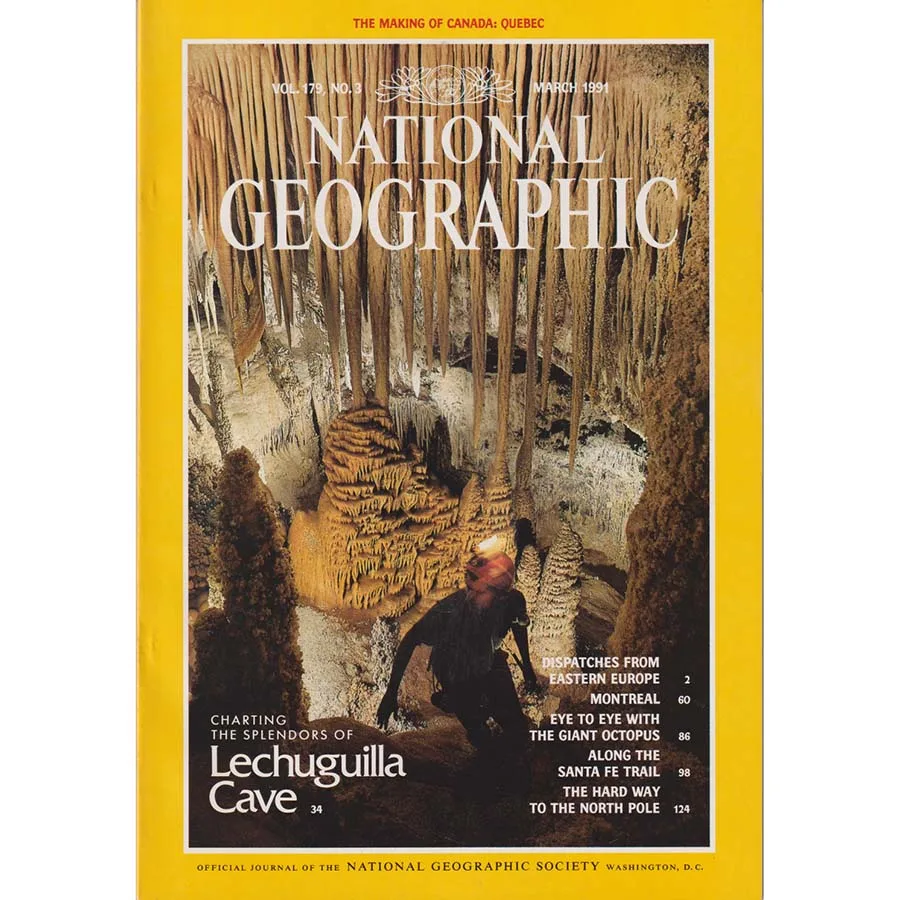
National Geographic, March 1991: the issue that politely invites you underground, hands you a headlamp, and then reveals a cave so outrageously spiky and cathedral-like that you immediately understand why humans invented the word “splendour” in the first place.
The headline feature is Charting the Splendors of Lechuguilla Cave, and the cover photo is pure “you are not in Kansas anymore” energy: a lone caver dwarfed by a dripping forest of stalactites and strange mineral formations, like the inside of the Earth has been quietly growing its own gothic sculpture garden for millennia. Lechuguilla isn’t just a hole in the ground; it’s an entire secret world—fragile, alien, and so slow-built that your brain has to recalibrate its sense of time. Nat Geo, naturally, is thrilled by the idea that the planet still has places that feel genuinely undiscovered.
And the irony is that the most spectacular journey in this issue goes down, not out. No horizon. No sweeping vistas. Just mud, darkness, and the occasional moment where you realise the “floor” you’re standing on took longer to form than most civilisations have existed. It’s the kind of article that makes you appreciate the Earth as an artist with unlimited patience and a mild obsession with calcium carbonate.
But don’t worry—National Geographic also does what it does best: it opens five more doors and expects you to casually stroll through all of them:
-
Dispatches from Eastern Europe – a very 1991 thread, right on the hinge of history. The region in transition, reality changing faster than the ink can dry, and Nat Geo trying to capture the human texture behind the headlines.
-
Montreal – because after crawling through a cave, why not pop up in a great city? Expect culture, identity, language, food, and that particular Montreal charm that somehow feels both European and North American while also being entirely its own thing.
-
Eye to Eye with the Giant Octopus – and here’s your favourite Nat Geo trap: you think it’s a fun sea creature piece, and then you’re 10 pages in, genuinely unsettled by how intelligent and otherworldly an octopus can be. Respectfully, they are basically underwater wizards.
-
Along the Santa Fe Trail – history you can travel through, landscape as narrative, the sense of movement and expansion and consequence, all mapped onto dust, distance, and memory.
-
The Hard Way to the North Pole – which is Nat Geo code for “people voluntarily suffering in ice and wind for a sense of achievement.” Expect endurance, cold that feels personal, and the quiet madness of progress measured in small, heroic steps.
And perched at the very top: The Making of Canada: Quebec—a reminder that this era loved a good long-running series, the way your favourite TV show likes to drop subplots that eventually become the main story.
Condition: Good, which is exactly right for a 1991 issue: solid, readable, and still thick with that old-school Nat Geo confidence—long features, rich photography, and an assumption you’ll happily spend an evening in a cave, then Eastern Europe, then Montreal, then underwater with an octopus, then on a historic trail, then freezing near the pole. Sold by Crappy Old Books, naturally, because the best way to acquire subterranean wonder and globe-spanning whiplash is from a seller whose name suggests the shelves are slightly chaotic but the finds are brilliant.
If you want a National Geographic that feels like six documentaries and a geology lesson in one—March 1991 is a belter. Come for the cave. Stay for the octopus. Leave with a sudden respect for darkness, distance, and anything that can grow a stalactite one drip at a time.
Keep browsing: See more National Geographic books Other books by National Geographic
